Pages

Showing posts with label culture. Show all posts

Sunday, March 29, 2015

My article in Cricbuzz!

When I went to London in high school, the hotel helpfully provided a 'basics of cricket' leaflet for its foreign guests. I looked at it, thought it was too confusing, and didn't bother learning anything about it at all.

Then I moved to India, where it was certainly necessary to learn the basics.

But I never thought I'd get an article published in a well-known online cricket news site!

Read it here:


Thanks to G. Rajaraman for forcing me to put my thoughts into written word form :)

Friday, February 14, 2014

A Valentine's Day tradition

Okay, maybe it's just MY tradition. But when I was an unattached freshman in college, all my new friends around me joining sororities, meeting guys, pairing off, I wasn't really looking at Valentine's Day as something particularly exciting to celebrate. But I didn't want to be bitter.

So I went to the local toy store, bought beanie lizards for all my single friends, and gave them out with ribbons tied around their necks. Ever since then, I've given little beanie lizards to my friends -- single or attached, Valentine's Day or not -- as expressions of love. Like flowers or chocolate, but cuter.

Happy Valentine's Day! Here's a lizard.
I never thought of Valentine's Day as a couples-only holiday anyway. My parents would always give me Valentine's gifts - heart-shaped earrings, chocolates, cassette tapes. And I would always make cards for them. A religious group in India has declared 14 Februrary to be Parents Worship Day so that the youth aren't tempted to celebrate Valentine's Day with their 'premik' or 'premika' ... but why not both? Love isn't just for boyfriends and girlfriends. We love our parents, children, siblings, friends, and pets too. Why limit Valentine's Day to just expectations of romance and extremely expensive roses? Don't we need more love in the world; less hatred and division? Why not have a day to commemmorate love, of all kinds?

Life is short and we don't know if we're going to be here tomorrow. Tell those you love that you love them. And, if you're so inclined, give them a lizard. 

Thursday, February 6, 2014

Exploring the local culture - Pacific Northwest edition

Memorial Day Trip to Mt. St. Helens, 2013
Photo courtesy Jayanta Mondal
I have been in the Pacific Northwest now for three years and I absolutely love living here. At times I wish I was closer to Seattle, or Portland (Portland. Yes. Please?) but as my dad always said, "home is where you hang your hat." And I certainly need a lot of hats here!

Being a "Ph.D. wife," I'm aware that we may not be in this area much longer. It could be another year, maybe two; likely not more than that. And one of the things I regret the most about my short time in Louisiana was all the things I didn't do. I was always an outsider and never really integrated into the culture there -- I never even did the stereotypically touristy things like swamp tours or visiting the Tabasco factory in Grand Isle! Of course, I didn't expect to ever not be an outsider, but I admit I didn't really try very hard to meet people or build relationships there until right before I left.

I don't want to make those mistakes here. It's very easy to get caught up in the web of Life, of chores and cooking and work and internet and not really experience a lot of what the area you live in has to offer. It's easy to not put yourself out there, be vulnerable, make friends or at least acquaintances. I don't expect everyone to roll out the red carpet for me, but I want to put myself where the people are and live here, not just exist here.

So here are some of the things that I have done, or want to do, in the short time I have left here:
The only tomatoes we were able to grow!
They weren't supposed to be grape
tomatoes, but that's what happened...

  • Get involved in outdoor recreation. We've done this, in part. We biked a lot in 2011 and 2012, but A's bike was stolen when we went to India this year and he's not interested in getting another, so we may need to change up our activity. Hiking, perhaps? We went camping with some friends over Memorial Day weekend last year and it was one of the best trips I've ever been on. I have also just started cross-country skiing and want to keep it up as long as there's snow on the ground. I can go weekly with a small group from the college. I don't think I'll ever be one of those people who goes rock climbing one weekend, kayaking the next, and runs a marathon the following month, but I would like to make outdoor fun in the fresh air a more regular part of my lifestyle, be it cross-country skiing, the occasional camping trip, or just taking a walk at the arboretum. 
  • Buy our food from the local farmers market. We do this when the market's in session and we love it! We joined the university CSA in 2011 and although we probably won't join again due to uncertainty of when we will leave, it was great to be able to pick up local, organic, fresh produce on a weekly basis and then have fun trying to figure out what to do with it. Once we get settled somewhere, I'll look around for similar programs in that place. The farmers market is also good though. It's really an all-morning event. This year, I'd like to go weekly if possible.
  • Volunteer on a farm. Our local co-op has a program where members (of which I am one) can go volunteer on local farms and really see where our food comes from, up close and personal. I just found out about it this winter, and am hoping to be able to do this in the spring. I have gone apple, cherry, and raspberry picking which is always super fun and economical if you like eating a lot of fruit. 
    picking apples at the Organic Farm

  • Sing in the local chorus. Done, and done. Concert is May 3 and 4. Please come!
  • Join a spiritual community. I am involved with our local Sanatan Dharma center, but not regularly. At this time in my life this is something that is difficult to work in for many reasons, most of which are not bloggable. I do think after I have a family it will be something I will want to be more of a priority in my life. 
  • Attend collegiate arts and sporting events. I have not done this yet but 2014 will be the year. The local universities have so much to offer. I already sing in India night events but I think I should be more of an attendee and not a performer as well.  As far as sports go, I'm not really a big football fan, plus that's already got a lot of support, so perhaps I will come out and support the tennis team? Or baseball? Or women's basketball! I also just found out that the university is putting on Die Fledermaus on the one weekend I'm not singing in April so I will likely be attending that too! 
  • Sing more. The problem with college towns is that everyone moves away, and most of the people I sang and played music with when I first came here have done exactly that. But just yesterday I talked to a girl at the other university who knows a guy who plays guitar and wants to have a jam session... so let's see if we can get Round Two up and running!
  • Go to local wineries. We've already done a lot of regional trips when A's parents came to visit us - Portland, Seattle, National Parks, local attractions. There are a few other places I'd like to go, but the Columbia Valley wineries are at the top of the list. This is a big to-do for this spring.
So that's really my Pacific Northwest Bucket List. Anything else you think I should add? 

Friday, October 11, 2013

The one about the bindi

I have been asked a few times to write about bindis - can white women wear them? Should we? Or should we err on the side of caution and never wear anything from other cultures? Do the rules change if we are Hindu? Or if we're married to an Indian?

So many questions. The problem is that I'm not really qualified to answer them. I can only tell you that I sometimes wear them in certain situations, why I do, and why I don't in others.

I don't wear them on the regular just because I can and it's a free country.

I do wear a bindi when I go to the temple and when I go to certain Indian festivals and cultural events - Durga Puja? Yes! International Day street fair? No! University's India Night? Sometimes. It depends on the context.

I also wear them in India because in the area my husband is from, it is ubiquitous. The day after my wedding, my mother-in-law gave me a small packet of bindi cards; I did not wear them right away as our wedding was in the US but I made sure to wear the ones she gave me daily when we went to his home. It is one small thing that can help to put his family at ease, a marker that I accept and embrace his culture (he makes no secret of the fact he accepts and embraces mine). 

So why don't I generally wear them in the US? Aren't they fashionable? Aren't I connected to the Indian community here? Aren't I married to an Indian? To tell the truth, it is exactly for these reasons that I don't.

Apparently the bindi has been "on trend" for about a year now. I am not terribly on the up-and-up regarding such things; my utilitarian approach to fashion is limited to finding things that look good on me, aren't dated, but will last me twenty years; and to check and see if skinny jeans are over yet. But generally I have seen that when something becomes "trendy," a lot of license is taken with it. Fashion is both art and business; a couple years ago when biker chic was all the rage, you could find rivets on everything from handbags to shoes, none of which need rivets in the first place. It started as something artsy and novel, and then suddenly it was everywhere because it sold. The same has happened with bindis. The predominantly white fashion industry took a very visible marker of Indian tradition and culture and removed it entirely from its cultural contexts. Perhaps because it isn't as jarring to the average white person as, say, a leather mini and pasties accessorized by a white tulle Catholic wedding veil, bindis became accessories to cutoffs and see-through shirts, not just on the ramp but on the streets of Brooklyn and Seattle. And somewhere, gestalt in the world of fashion design died a slow and painful death.

As someone with a self-described utilitarian sense of fashion, I could not get behind the bindi trend for the simple reason that it makes absolutely no sense. But then there is a question of the morality of the trend. I find it odd that someone who would likely never wear fur because it hurts animals would wear a bindi in such a way that it hurts an Indian woman. (It can and does; I can link you to narrative after narrative after narrative.) Is this the cost of my self-expression? I think this is one trend that I can't afford to partake in.

Just one example of this: Have you seen some of the pictures in the bindi tag on Tumblr? Vacant-eyed, nubile girls wearing little more than a bindi with #exotic and #indian tagged...the orientalist stereotype of the oversexed, dark, exotic other is pretty played out in 2013 but these girls are jumping right on the "exotic=sexually available" bandwagon without even realizing it. I certainly do not want to reinforce a stereotype of a "bindi-wearer" as an object of lust, especially when I know and love many women who wear bindis as an expression of their culture or their faith. I am not interested in making their lives any more difficult.

So yes - the (white-dominated) fashion industry has taken the bindi, stripped it of context, and reduced it to a sign of exotic Otherness. And the ambassadors of this trend? Gwen Stefani, who has silent Japanese girls follow her wherever she goes? Selena Gomez, who doesn't even know the bindi is Indian in origin? Not exactly my role models. 

I said earlier that there's another reason I don't wear a bindi in daily life, and that is because I'm married to an Indian and have many Indian friends. This isn't counterintuitive. My Indian friends, with the exception of a religious few who wear kumkum, not sticker bindis, generally do not wear bindis themselves, except to temple or cultural events. What reason do I have to do any different? There's another reason too; I do not wish to invite unfavorable comparisons between me and my friends - "Andrea is more Indian than you! You have become so westernized." "It is nice to see a foreigner embracing our culture that others choose to reject." I have heard these things said in my presence. Awkward. Not every Indian woman wants to wear a sari, bindi, sindoor, glass bangles, toe rings. Many have fought their families, school principals, and surrounding culture to leave these things aside. Am I, by my choosing to embrace certain aspects of Indian culture, making it more difficult for the Indian women I know to make their own choices? I will be happy to remove my bindi in solidarity with them.

This is not to say that I think that white people should stay away from other cultures entirely. I do wear bindis in certain situations. I also choose to wear a wedding ring, loha, and sindoor, and choose not to eat beef, in the interest of carrying on family traditions and making my family members more comfortable. There are those who will not be okay with this; I deeply regret this but consider my commitment to my family to be paramount. I believe that there is a place for cultural sharing and syncretism, and that place is within community. Intercultural families, religious communities, close circles of trusted friends. And this sharing happens naturally, just as you would share information on what wine to serve with chicken or the best cloth diapers for your baby. It's other-centered, relationship-centered; not self-centered. The more involved I got with my local Indian community, the more I learned about various aspects of Indian culture from Indians and not from Wikipedia, the less inclined I was to just participate in the sparkly, pretty parts of the culture just to do it. Those parts come in context - for me, it is as the White American wife of a not very religious Indian Bengali, living in a small college town and all the good things and problems therein. 

A final criticism some will have is that this is a tempest in a teapot; this is an election year in India, the US government is shut down, and people have a lot more to worry about than what carefree white girls are wearing on their faces. I disagree; I think that first of all, white people have done a lot of taking and appropriation and we need to recognize that fact. We are products of our history and as such, even this issue of something as small as a dot requires a need for understanding on the part of us white girls, doing things that may not come naturally -- listening to the narratives of those whose culture we have embraced in part, learning about the context of that culture through a living community and true relationships, and accepting that even as we are individuals who make our own choices in life, those choices do affect others and we need to be aware of the consequences and our impact. In this light, we may not always get to wear whatever we want. And we may not always be able to please everybody. But pleasing people was never the goal; it's not about us. It's about how our actions show respect to others who generously share their culture with us, and how we can do our part to bring about more justice in this world. 

(Note: much of this was inspired by, and indeed written first in, a series of comments I made on Reddit in October 2013.)

Wednesday, September 11, 2013

Words worth sharing today

"Sectarianism, bigotry, and its horrible descendant, fanaticism, have long possessed this beautiful earth. They have filled the earth with violence, drenched it often and often with human blood, destroyed civilization and sent whole nations to despair. Had it not been for these horrible demons, human society would be far more advanced than it is now. But their time is come; and I fervently hope that the bell that tolled this morning in honor of this convention may be the death-knell of all fanaticism, of all persecutions with the sword or with the pen, and of all uncharitable feelings between persons wending their way to the same goal."

- Swami Vivekananda, Welcome address to the World Parliament of Religions, Chicago, September 11, 1893. 

120 years later, we are still fervently hoping. 

Monday, August 12, 2013

Yes, Virginia, you do have a culture

A lot of bloggers have been blogging today about the perception some  people have that America doesn't have a culture of its own. Instead of echoing all the wonderful things that have already been said, I'd like to explore this idea a bit and think about why it is that people think this way.

The first thing to be clear on is the definition of culture that you're working with. Some people mean things like going to opera, eating fine food, or reading intellectual books when they speak of "culture." Others use the term keeping things like dressing styles, jewelry, music, and other art forms in mind. Even with either of these mindsets, it is fairly clear that Americans do, indeed, have a culture (or a few cultures!) and that any statement to the contrary is metaphorical and intended to judge the quality of American culture, which is of course a subjective measurement. In this case, it is good to look at who's doing the talking. Is it an American who actively rejects components of American culture? Is it someone of another culture who views their culture as superior? It is more likely than not that you cannot have an intellectual discussion on culture with either of these people, as their minds are already made up; to them I say To each their own and go on about my merry way.

A very broad definition of culture used by anthropologists is "that complex whole which includes knowledge, belief, art, morals, law, custom, and any other capabilities and habits acquired by man as a member of society." This is the definition that I will be using throughout this entry, with the caveats that culture is not monolithic - there is always local and individual variance - and that cultures are continually changing.

For those people who are not using the term "culture" as a subjective measure of how refined, advanced, colorful, or traditional a culture is, many may still not think that the United States has a culture -- or that they, particularly, do not have a culture -- because they are constantly surrounded by their culture and just see it as normal. Derek Sivers once wrote an essay on this, using the metaphor "A fish doesn't know what water is." We land-dwellers know that water is an important part of a fish's environment, but the fish doesn't know anything else until he's caught! This is particularly true for White American culture, which is so pervasive in media and the world around us that it doesn't seem there is anything "cultural" about it. In fact, it is often seen as the 'norm' and anything that deviates from that 'norm' is considered 'cultural' or 'ethnic.' Let's look at food as an example. Hamburgers, French fries, spaghetti, meat loaf, chicken and dumplings, turkey and dressing, pizza are all seen as 'regular' or 'normal' food. You will find them in most any diner or cafe, and on nearly every children's menu, regardless of cuisine in the United States. Do we ever really think about the fact that hamburgers are named after Hamburg, that spaghetti is Italian? I had to Google to find the origin of meatloaf (likely also German). These are not "ethnic" foods to Americans even though they have origins outside of the country. They have blended into our cultural landscape in ways that things like empanadas, pho, samosas, kimchi, and even oxtail soup and collard greens have not.

This inability to see the culture that surrounds us, that has 'simmered down' into Americana after twelve to fifteen generations in this country, becomes even greater in conjunction with the "us vs. them" narrative that pervades American culture from our children's games of Cowboys and Indians to our history lessons on Manifest Destiny and even orientalist portrayals of "faraway lands" in movies such as Aladdin and the Indiana Jones films. Movies such as Avatar, The Last Samurai, and Dances With Wolves take a relatable white character and plop him down in the midst of the Other and the story arc is always the same: struggle with the other culture's Exotic Ways, become tolerant enough to learn some of their ways, and in the end save the people who due to their Exotic Ways, were unable to save themselves. Eat Pray Love does a similar thing; I really do not like books and movies of this genre because they further the narrative that the only way you can "find yourself" is by going to some far-off destination where people are simpler or more spiritual than yourself and your rotten culture. A spiritual life is found where you look for it; you don't have to jet halfway around the world to find a god or supreme power that is supposed to be everywhere at once.

The truth is that there is nothing truly exotic. Everything is normal if you are used to it. There is nothing magical or special about a siesta if everyone's taking one and that's just what you do. A sari is everyday wear for many women in India and does not imbue anyone with spirituality in the mere act of wearing it. And the shorts and tank top you are wearing right now may seem exotic in the eyes of someone who has never worn such a thing! Shorts and tank tops are very much part of American culture, as are saying please and thank you, taking food to bereaved families, and flipping the bird as a sign of disrespect. If you get a pop culture reference, if you say "Bless you" without thinking when someone sneezes, if you understand why your niece's Sweet Sixteen is a Big Deal and you shouldn't just skip it to play Xbox, if you have ever had a moment of nostalgia about a certain song, toy, movie, or game from your childhood, you can thank American culture for that.

And finally, if you're still not sure that there is culture in America, just Google "buzzfeed" and your city or state's name. Likely you will come up with a handy list of some of the greatest parts of your local culture, such as this one for the Rio Grande Valley, or the Bay Area, or New England, or even this one for Catholic school. You're already trained to see culture in faraway places; it's only when you can see it in the place you are from as well that you can really communicate interculturally without ideas of what is 'normal' and 'exotic' or value judgments getting in the way.

This blog post is part of a carnival on "not having a culture." You can read others' posts on the same topic at:
Americans Don't Have a Culture at Authentic Journeys
Really? Yoopers Have No Culture - The West Has Culture at AttachedMoms
Swiss Have No Culture at Cyn's Adventure in India
Southern Americans Have No Culture at American Punjaban PI

(And if you are wondering how I have finished this whole post and said nothing about Virginia, read the cultural reference behind the title at the Newseum site.)


Sunday, July 28, 2013

Why it doesn't matter that I might have a Native American ancestor (and why it does)

Many white families have a family legend of sorts that a far-off female ancestor was a "Cherokee princess." Mine does too, although to our credit, the word "princess" has never been mentioned. The Cherokee did not have princesses.

This relative is, by varying accounts, either my great-great-grandmother Hannah, born 1851, or my great-great-great-grandmother Susan, born 1829. Great-Great-Grandma Hannah has been described by living relatives as "full blood Indian," but other written histories of the family have noted that her mother, Susan, was Cherokee Indian. Beyond her, there are no records.

Because of the early dates, my relatives are not in the Dawes Rolls or any other archival records of Native Americans that I have found. There are other records though -- records showing that regardless of whatever my family members say, Great-Great-Grandma Hannah was listed as white in the census. So even if my family was Native American, they've been passing for white since the early 20th century and receiving all the privileges thereof. And in case you need to brush up on your history, that was not a very good time to be a "colored person" or an "Indian."

A lot of people, myself included, have gone on genealogical searches to find that long-lost Indian relative. We think it will explain our high cheekbones (got those) or our olive skin (not that though). And there is also the goal of Triumphant Documentation - the proof that will turn our family legends real. The name in the Dawes Rolls that shows, among all the families who say they have Native ancestry, that we make a legitimate claim. Perhaps there is also the idea that it will lend us a certain "minority cred" or an absolution of self-imposed white guilt - "I'm part {insert non-European ethnicity here} so I can't be racist, I can't have white privilege," et cetera.

But if we are even 1/8 Cherokee, or Peruvian, or Mongolian, aren't we still 7/8 European in descent? Does this one ancestor in our past (who may or may not have been matched willingly; love marriage is a relatively new phenomenon) negate our whiteness? That's the one-drop thinking of the racists of the past and I don't subscribe to it. I have grown up in White American culture. I guess you could even call me a WASP even though polo shirts don't look good on me and I've never summered at Nantucket, or however you're supposed to say that.

But this search has not been in vain. I have learned incredibly interesting things about my family history, including:

  • My family goes back at least ten generations in the US on both sides
  • Both my maternal and paternal lines (mom's mom's mom, etc. and dad's dad's dad, etc.) come from Ireland Way Back In The Day
  • My family history is almost all English and Irish, with some French via Quebec in more recent days, which may or may not explain my love affair with Canada
  • I had ancestors who were mercenaries in the Civil War; they decided to fight for the Confederacy because it paid more
  • I had another ancestor who led a rebellion against the Confederacy and got hanged for it
  • It is true that cousins married each other in the 1800s
  • Tales of mystery and intrigue that will remain in the family and not on this blog
I have gotten in touch with family members I never even knew I had. (When your grandfather is one of nineteen children, this is really not very surprising.)

And just as importantly, if not moreso, I have learned about issues facing the the Native Americans of today, and keep myself informed. I visited Tahlequah, Oklahoma twice - in 1998 and 2000 - and saw what life was like in the Cherokee Nation. I learned more about the Cherokee and about the issues they faced, from people who didn't have to do genealogy work to know their heritage. In more recent years, I have learned about the Idle No More movement in Canada and the US and have read about current events and issues that affect the Native American community closer to where I currently live.

I have been hesitant to involve myself too much, as I don't think I know very much at this point and want to educate myself more on the issues before becoming involved, as the goal is not "look at me, I'm one of you" (because really, I'm not) but rather "how can I be of support, quietly, in the background?"

I, like most people, began this search in search of what I could get. I wasn't looking for college scholarships or tribal lands, but maybe a sense of connection, of belonging, of being able to say that my claim to Native heritage was correct. But if indeed I ever did have a Native American ancestor, I suppose the best tribute to her memory is what I can learn, and bolstered by that knowledge, what I can teach.

Tuesday, April 9, 2013

"Accidental Racist" is accidentally racist

And honestly, I'm not that surprised.

I get the point that Brad Paisley is trying to make. The Confederate battle flag is a part of Southern culture. For better or worse, it just is. But does wearing it make him a racist? He's offended that people might think that. He's just a good ol' boy, tryin' to do no harm. And so he wrote a song about it.

I am not a scholar in critical race theory, but I have found the following things present in the song that do not help his argument that really, wearing the Confederate flag isn't racist:
  • Defensiveness ("And it ain't like you and me can rewrite history," "walkin' on eggshells")
  • White guilt ("Caught between southern pride and southern blame")
  • I have a black friend, and he approves, so it's okay ("If you don't judge my gold chains, I'll forget the iron chains")
  • Reductionism and lack of context ("They called it Reconstruction, fixed the buildings, dried some tears" -- Reconstruction was about way more than fixing buildings and drying tears, and there's nary a mention of Jim Crow, which set race relations in the South back even further than before the Civil War, besides that slavery thing)
And when I see the above things, I realize it's the same tired old argument, the same tired old white guilt that people feel proud of, defensive about, frustrated by, or all three at the same time.

I also know the importance narratives play when trying to decide if something is racist (not if someone is racist; the two are different things.) And while I understand that the Confederate battle flag is a part of Southern heritage, I also understand that there are people who are offended by or who feel nervous when they see it. It's even mentioned in the song ("I see that red flag and I think you wish I wasn't here"). Both narratives are important. But even while trying to do research for this post, I found a lot more hits for the "the Confederate flag is part of our Southern culture" narrative than for the "this makes me uncomfortable" narrative. I have a hard time believing that this symbol doesn't have deep negative meaning, at least for some. But why don't I hear their opinions? Why is that narrative reduced to one line in the song?

I hear a lot of white voices --including mine-- surrounding this issue; those who support the flag and those who do not. But where are the voices of people of color? Why can't I find them with simple Google searches? It seems Gayatri Chakravorty Spivak's question of whether the subaltern have a voice is still extremely relevant today. I cannot make an informed decision until I hear the narratives of those who are supposedly affected by the negativity inherent in the symbol.

But until then, Brad Paisley is not telling me anything I don't already know about the fact that white guilt exists and that it does absolutely nothing to confront the issue of racism. It just states his position and despite the inclusion of his "black friend" LL Cool J, does not seem to invite dialogue on the issue, but instead exhorts people to leave the past in the past and try to see this symbol so often construed as negative with the positive connotation he puts on it as a white Southerner instead.

Friday, April 5, 2013

Top 5 tips for staying safe in online relationships

The internet has made this a very small world, indeed. Thanks to social media, we can make friends, business connections, and even find love with someone on the opposite side of the world.

But even as the benefits are amplified, so are the risks. It is easy to find someone you are compatible with, but at the same time, easy for someone with ill intent to find you.

The online dating game is complicated enough as it is without these shady characters, who more often than not fall into one of the following two categories:

Catfish - Those who create fake online profiles to lure unsuspecting people into a fake relationship for no apparent personal gain. Sometimes they are cyberbullies, people known to the victim playing a cruel trick, and at other times they're just trolls, people with nothing better to do than string along an innocent person for what they believe to be the fun of it. Sometimes they do it just to be able to tell their friends about their "internet girlfriend/boyfriend" or for sexual gratification. The name comes from the 2010 film Catfish, which was a documentary of one such fake online relationship.

Scammers  - These people will enter into online relationships, under real or fake profiles, with personal gain at the basis instead of love. They will often prey on certain subgroups or subcultures who may be more vulnerable to their advances. The gains they hope to get could be anything from gifts to money to plane tickets to visas, with some scammers going so far as to marry their victims for residency in a foreign country then leaving them once that residency is secure, or to end up getting them involved in drug trafficking schemes.

Much has been said about safe online dating, and I encourage you to read the linked posts at the bottom of this entry for more information on the topic, but here are my top five tips for avoiding catfish and scammers:

1. Know Thyself. Step away from the computer for a moment and go look in the mirror. Think about where you are in your life right now. Have you just exited a relationship? Had a string of relationships go bad? How's your self-esteem? Those horrible messages society tells you about what a woman/man "should be" - are you letting them affect you? Is that go get 'em attitude really from the heart, or is it bravado? Be honest with yourself; no one is listening but you. 

This is not to say that if you are in a delicate position, that you should not be looking for love; just that if you are not in a good place emotionally, you may be much more vulnerable to scammers and catfish, and you need to be sure to protect yourself even more than usual during this time. Be choosy; you deserve something good in your life. Don't just fall for the first guy who tells you you're beautiful or the first woman who shows an interest because they like you

Sometimes it does mean to step away from the dating scene for a while and get back in touch with yourself and your own wants and needs. If this is the case, don't resist it. If you need therapy to work through some tough times in your past, go get the help you need. But if you are ready to move on and put yourself out there, tread lightly and carefully at first. 

2. Heart Must Listen To Head. One of the most important things you can do to protect yourself is to make sure that what you are hearing from your online love interest is consistent. Sometimes it's easy to make excuses for people when their stories don't add up. Sometimes they are quick to make those excuses themselves. But if something doesn't make sense, find out why. Don't just ignore it. If he uses multiple names, or if she tells you she lives in one city but all her Instagram pictures are geotagged to another location, that could be a red flag. If he's asked you to go on the webcam but says he doesn't have one, or if she won't send a picture of herself when she's asked for yours, that's an asymmetrical relationship and there is definitely something wrong there. 

If you get a gut feeling that something doesn't add up, it's quite likely that it doesn't. Also be aware of inconsistencies between what someone says and what they do. He's very religious, but he tells you that you don't have to convert to his faith when you marry even as he posts videos of people who converted from your faith to his on his Facebook wall? She says she doesn't care if you don't have a six-pack but retweets photos of scantily clad gym rats? He says you look sexy in that halter top but agrees with posts where his friends say "women should dress decently"? Inconsistency between someone's words and their actions is a major red flag.

3. Culture Is Not An Excuse. Yes, cultural differences exist. No, they are not an excuse for you to be disrespected. If you are in a real relationship, you will discuss the things that make you feel slighted and if the other person cares, they will do what they can to make sure that those things do not happen. If you feel disrespected when someone does not come online at a predetermined time, and she doesn't even try to come online at that time, that's not fair to you. (It goes both ways; if you make disparaging remarks about their family due to their hesitation to accept your relationship and that hurts his feelings, stop doing it.)

This applies to gender relations too. Do not allow anyone to treat you as a second-class citizen or subject you to behaviors that are physically or emotionally abusive because of preconceived notions about "the way it is done in his culture." All over the globe, women are fighting battles within their own cultural contexts for rights and respect. Do not rationalize away behavior that at first glance seems not okay to you as something you have to "compromise on" because "that is just the way it is over there." Chauvinism and abuse are traits and behaviors of the individual; you cannot paint an entire culture with a broad brush in this matter. 

That said, if you are in an intercultural online relationship, you need to learn more about the culture of the person you're in a relationship with, and they should learn about your culture as well. There are issues that intercultural couples will face, but you need to work through those together, with mutual love and respect. If they want you to know everything about their culture - or you go down that path willingly - but they show no desire or put forth no effort to learn about yours, again, you're in an asymmetrical relationship, which may be the sign of a catfish or a scammer. Learning some of their language is also a good idea. I have witnessed a situation where an ostensibly peace-loving person was matched up with someone who subscribed to hate groups publicly online - but she didn't know that, because she couldn't understand what the groups' names meant. (And if you are in an online relationship and you have not stalked their Facebook profile, ask yourself why you haven't done that, and then go do it right away.)

4. You Can't Hurry Love. Relationships take time to build. You cannot fall in love at first text. Be cautious at first and open up much later, after trust has been built. Anyone who truly loves you should respect your boundaries (and if you love yourself, you'll have boundaries; if you have questions, please refer to #1 in this list). Similarly, anyone who says to you "I saw your profile picture and I fell in love" is not using correct terminology. They may have fallen in lust, or they may have gotten interested and wanted to get to know you better, but love's not there yet. 

Don't rush into something because you're afraid this could be your very last chance (likely, it's not) or because no one's ever shown you that kind of attention (attention and love are not the same thing) or because no one that beautiful will ever write to you again (if it seems too good to be true, it often is.) And if they are telling you any of those things, block them and run for the hills. 

There are people out there who believe in "soul mates" or "twin flames" and will drop anything and everything the moment that they think they have found that other, missing half. This doesn't make sense. If it is really true that this person is your soul mate, then why not wait? If they really are your soul mate, they'll understand that you want to take things slowly. If you're talking about someone you're linked to for eternity, six months or a year of getting to know each other isn't even a drop of water in that great ocean of time. You don't have to rush anything. 

Others do not believe in soul mates, but instead believe that there are people we are compatible with, but none of us is a half person waiting for our other half. They believe that relationships are two whole people who, together, are greater than the sum of their parts. In this case as well, growing trust over time is important and necessary. You don't want to make any major decisions based on a superficial understanding of your compatibility and only after knowing them realize that you just didn't know them well enough.

5. Would You Tolerate This In Person? They always say they'll come online but they never do. They promise to meet up when you visit their city, but when you go, they give excuses. The only thing they can talk about is how sexy you are. They don't ever want to talk about politics or basketball or social justice or the Kardashians or whatever it is that floats your boat. They don't like it when you ask them personal questions. They ask you for money just after you meet them. They ask you to do things on webcam you're not okay with. Your relationship seems never to progress beyond a superficial level.

Are these things you would tolerate in an in-person, bricks-and-mortar, meatspace relationship? 

Online relationships are often more difficult than in-person ones because you lose so much communicative ability. Pictures can be Photoshopped. You can't respond to someone's facial expression or body language using Facebook chat. Even on the phone, where at least you have tone of voice, you can't divine the environment, and even video chat only gives you one angle - and some say they may have been involved in fraudulent video chats as well! There is so much you cannot be sure of, so anything you could not tolerate in an in-person relationship must not be given a pass in an online one. 

Of course, this is just scratching the surface. Staying safe online takes common sense, a healthy dose of self-respect and respect for others, and being aware of the ways in which you are vulnerable and you can get taken advantage of, so that you don't. Here are some other useful links on the subject:


{Thanks to Maria S. and American Punjaban PI for their valuable advice in the creation of this entry.}

Tuesday, February 12, 2013

Teach our children well

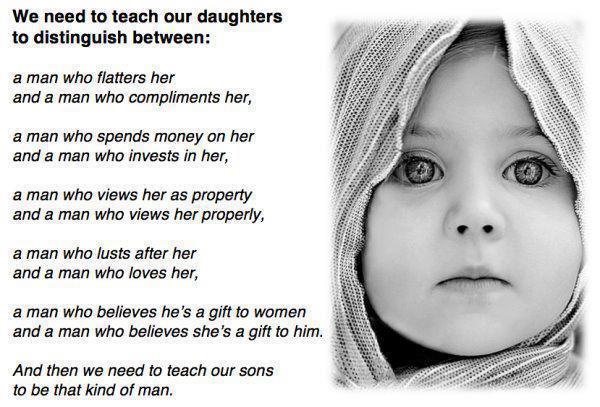
I think we all have seen this image floating around on Facebook:


I agree with this. It is excellent advice for today's world. I also think we can switch the gender nouns and pronouns on many of them and apply it to our sons. Not all, since we do not live in a world where the genders are completely equal in terms of power. I might, however, put it like this:

We need to teach our sons to distinguish between:
A woman who flatters him and a woman who compliments him,
A woman who expects him to spend money and a woman who expects him to spend time,
A woman who wishes to be property and a woman who wishes to be equal,
A woman who lusts after him and a woman who loves him,
A woman who believes she's a gift to men and a woman who believes he's a gift to her,
And to teach our daughters to be that kind of woman.

Only the second and third reflect our unequal power structures that remain in society today - commonly known as the patriarchy. And patriarchy is not the small-minded idea of a World of Evil Men; it is simply a society that values men over women, and both men and women take part in reinforcing it. (Note that patriarchy hurts men as well as women, commodifying them and confining them to narrow definitions and forcing them into 'traditionally masculine' roles instead of allowing them choices.)

Avicenna recently blogged about this next image that has been making the rounds (click to enlarge):


As you can see, it is a response to the first image that comes out of hurt and mistrust - common themes of the Men's Rights Activist (MRA) movement. They operate on the assumption that there is a war between the sexes and it is a zero-sum game, and that feminists are their enemies, not their allies. 

Here is my response to this response (edited slightly from what I wrote in Avicenna's comment section):
I am really actually quite okay with all the “and a woman who…” statements except for the first one, which could be worded in a less snarky manner.
Teaching our daughters to be good communicators? Teaching them responsibility? Empathy? Loving someone for their character? I’m down for that. We should teach our sons the same things.
I have a huge problem with the first part of every single one of those statements though, because each one is a consequence of patriarchy, the same system that MRAs say does not exist outside of Women's Studies 101 classrooms.
Why do some women expect men will pay for them? Because in the past, it was their responsibility to, since women were financially dependent on men. Feminism has made it possible for women to earn their own money and go dutch on dates. Yet MRAs hate feminism.
Why do women hint, to the point of deception sometimes? Because in the past, they would be disregarded if they stated their wants, needs and opinions at best, and beaten at worst. Feminism has made it acceptable for women to have opinions without fear of retribution. Yet MRAs hate feminism.
Why do women regret sex? Because a woman who enjoys sex or a one-night stand is seen badly in the eyes of society. Why do some of them “claim date rape”? Because either 1) they were date raped, or 2) it is better in society’s eyes for them to be a victim than a slut. Feminism is WORKING on this one; we are trying to convince society that women are more valuable than their hymens. Yet MRAs hate feminism.
Why would a woman expect a man to “man up” ? Because she, too, has internalized the gender roles that show a ‘man’ to be very certain and specific things in today’s society. (I am unsure how this has to do with agreeing with her all the time, unless of course, this is an unspoken fear that women will do to men what men have done to women for centuries.) Feminism is dead set on questioning these gender roles that say men must do or be certain things to fit a standard of masculinity, and women must do or be certain things to fit a standard of femininity. Yet MRAs hate feminism.
Why would a woman love a man for what he can give her? Because she has internalized the patriarchal myth that she is nothing without a man, and that her value is based on the things he provides for her. Feminism encourages women to find worth in their own selves and provide for themselves, that they may meet men as equals and not as dispensers of financial security. Yet MRAs hate feminism.

Feminists and men's rights activists should be each other's best friends, working in solidarity for a better world where people see each other as humans, and where all people can make choices that best suit them and be free from fear and abuse. Unfortunately, the few times I have made this suggestion to MRAs, I just hear the same old talk about how feminism is the problem, and I have stopped trying. 

Men are not the problem.  The system is the problem.

This is not a zero-sum game. 

If a woman gains a right, it does not mean that a man is having one taken away.

Let us teach our children how to live in a respectful, just, and equal society.

Saturday, January 12, 2013

It's as crazy as it's ever been, love's a stranger all around

I haven't posted in a long while, and that's because there has been so much to write about.

So much I don't feel qualified to write about.

Twenty-six people died at Sandy Hook Elementary School, twenty of them children, on December 14 of last year, bringing the total to 88 fewer people in this world because of some madman with a gun. The typical knee-jerk reactions of 'ban guns' and 'lock up the crazies' reverberated around the internets for some time, but then the NFL playoffs started and celebrities did stupid things and no one cared anymore. Simplistic and myopic solutions aren't anything you can rally around. I sit here wondering how I can advocate for better preventive mental health care in my community, but no one wants to talk about that.

A girl was brutally raped in New Delhi, and died days later in a Singapore hospital from her injuries. This news hit home pretty hard for me, as I frequented the same theater she had gone to, had difficulty getting rides back to the general area of town she lived in, and the place she and her friend were deposited after their torturous experience was on the road I traveled daily to go back and forth from work. My mind's eye cannot stop picturing that scene - two naked, bleeding bodies lying in the cold foggy night, perhaps in front of  the dentist's office, or the tire shop, shutters down. People all around saw and minded their own business. Civic sense did not exist. But it was still the straw that broke the camel's back; now people have started talking about rape in terms of power, in terms of drawing shame upon the rapist and not the victim; calls for changing the system from the ground up are being made -- but are they heeded? Outside the Internet, has anything really changed? Rapes are still happening. I suppose it is the trend we should be looking at. In five years, will women stop telling each other not to go out on the streets? Will the term 'pervert' have replaced 'eve-teaser' ? All we can do is just make tiny steps in the direction of justice.

It takes much more than talk, more than pontificating on the Internet, to change things. But talking - and listening - are still so very important. The words we use are important. Loner, loser, reject, crazy; slut, whore, dented and painted women - why do we say these things about others? Why do we say things and act in ways that push people to the margins? Are we simply trying to make ourselves look good in comparison, glad we are not 'one of those people' -- deep down, we know that there but for the grace of God we go. Marginalizing others leads to the disconnect, the lack of community that breeds a madman. Demonizing women for being women, upholding the virgin/whore dichotomy which relegates women to the status of baby factories and sex toys, leads to a culture where rape is normalized as a way for men to discredit other men and remind women of their place. Neither one is just.

The battle has raged for years in epistemological circles - does language influence culture, or is it simply the other way around? I do think that the influence does go both ways, and that as we change our language, we can start to move toward less inflammatory and more logical ways of dealing with others and moving toward a better joint future. This is not saying we should be ultra politically-correct all the time; just that the words and labels we use for others should give them respect instead of take it away.

It's not much in the face of these huge problems facing our societies today, but it is one place to start.

Wednesday, November 28, 2012

Why I do not identify with the word "gori"

"Yeh gori kahaan se mila yaar?"

With a wink and a nudge, this was the first time I'd heard the word 'gori' actually spoken out loud. I'd heard it in songs referring to the color of a pretty Indian girl's cheeks, movie dialogues talking about the village belle, but this time it referred to me, and it wasn't complimentary.

From the tone of voice and the body language, the speaker saw me as his friend's latest fling. I was not his fling at all; simply a platonic friend. But the implication was evident, and I shot him a dirty look while my friend explained that I actually knew Hindi. He didn't say another word to me the entire evening.

So what does gori mean, anyway? Shabdkosh.com says it is an adjective meaning "fair." Even Urban Dictionary describes it as "a word used by Indians to describe white girls...not particularly offensive." And we've all heard it in songs like "Yeh kali kali ankhen, yeh gori gori gaal" to describe a woman's beauty. The male equivalent, gora, I've mostly only heard in relation to white men, not to a fair-skinned South Asian man.

So the denotation isn't too bad. But the connotation can vary. When it's used in a purely South Asian context, to describe a South Asian, it is generally a very positive term, albeit because of the shadeism present in South Asian culture, which is a separate issue. However, from my experiences in India, when the subject of discussion was a white woman, I never heard it used with a positive connotation. Sometimes it would be neutral, albeit objectifying - "Yeah, the gori's coming with us." Sometimes patronizing - "It's so adorable to hear a gori speak Hindi." And certainly negative - "This club is full of goris, you'll definitely get laid tonight." Gora also carries a similar neutral to negative connotation, but without the sexual promiscuity connotation of gori (which merits its own post, but I won't be the one to write it!).

And then there's the reaction of the dadi (grandmother) in this video:


Having experienced all these not-so-glowing connotations of the word when it refers to people who look like me, it is just not a term that I use to refer to myself. It's not something I think I personally can "reclaim" from the onslaught of stereotypes that come along with the term as it refers to a non-South Asian woman. And it also follows that it makes me uncomfortable when I'm referred to as gori as well, by people of South Asian descent or not. It gives me a feeling that I am not being taken seriously by the person referring to me as such, that because of my inherent 'gori-ness,' there is no way I can or should be respected as a person separate from my skin tone and all the baggage that goes along with it. Gori is a term that trivializes me as a woman with ties to an Indian family and community. It gives off wrong impressions to people about who I am. If I was Indian, it would be a different story, but I'm not, and it isn't.

Plus, defining myself via my ethnicity, particularly through the lens of someone else's ethnicity, is not very appealing to me at all. I don't believe in colorblindness and a post-racial society does not exist, but at the same time I don't need to perpetuate divides by labeling myself in ethnic terms. It Otherizes me with white people, assuming to remove privilege that is not actually removed. For South Asians, it serves to underscore my privilege as well as imply everything else about 'gori-ness' - sexual availability, lack of culture, lack of respect for elders, egalitarian to the point of embarrassment, etc. And for everyone else, it signifies nothing anyway. What am I trying to prove, and to whom?

So what should I be referred to as, then? I don't mind referring to myself as a white woman in contexts where race is important. American - sure, why not? It's the term de mode for a United States citizen, which I am. I've used the terms non-Indian and non-Bengali in particular contexts as well. I have certainly taken on some aspects of Bengali culture but I don't consider myself Bengali or Bengali-American; my future kids will be, but I'm not. Does a Punjabi who marries a Bengali take on an entirely new ethnic identity? If not, why should I?

I guess if you want to refer to me as anything, 'that big nerd who writes about culture' is pretty apropos. 

Sunday, November 25, 2012

Hand-Pulled Rickshaws of Kolkata


"You can find every kind of transportation in Kolkata," he said to me proudly, as if I had the Richard Scarry book Cars and Trucks and Things that Go in front of me and was checking off each vehicle inside. If I had, I would have had to make notes in the margins of the ones that Richard Scarry did not include.

Rickety trams. Trains departing Howrah Station. The metro slinking underground; the autorickshaws plying their routes. Ambassador taxis and Maruti 800s and the extremely occasional Mercedes. Three-wheeled cycle rickshaws, bullock carts, and men carrying dozens of chickens suspended upside down on either side of the seat of their bicycles.

And the one you will not find in any other metro area in India, the hand-pulled rickshaw, saved from extinction in this city that clings to its past just as the rickshaw pullers clung to their age-old profession in the face of their possible ban. Whether a ban has actually been put in place I do not know, nor does it matter, since they still fill the Kolkata roads regardless.

I saw many jarring things on my first trip to Kolkata. Having lived in Delhi for nearly a year, the poverty no longer moved me, but the hammer and sickle painted on the side of buildings did. The urgent monsoon sky did. And these men, thin, gaunt, darkened by the sun, often barefoot, certainly did.

Anirban Saha has done a series of photographic sessions of these rickshaw-pullers. He portrays them in black and white, in sharp focus against the blurry sped-up background of modern Kolkata. The images are poignant, but viewing them brings back the same feelings of uneasiness at class distinction that I had when I first encountered them. Intellectually, I understand their importance to the day-to-day life in the city. I understand that they remain in Kolkata by choice and not entirely by compulsion. But for someone who grew up in an egalitarian society, watching one man be beast of burden for another is uncomfortable. Children riding to school does not affect me in the same way as the fat man in a business suit, riding in broad daylight when he could easily walk. And I know I could never sit in one.

Perhaps this is what makes the most uneasy about the entire situation. It is a world I encountered, but not my world. As a foreigner, I cannot enter into that sphere. Availing myself of a ride is an image that smacks of colonialism and flies in the face of my generally-egalitarian nature. And if it were I who were taking the photos, instead of the talented Mr. Saha, it would be nothing more than poverty porn. This has little to do with skin color. He, as a lifelong resident of Kolkata, has interacted with this world from his childhood, perhaps even rode to school with a classmate or two in such a rickshaw. His eyes and his camera lens see as perfect sense what I see as cognitive dissonance. And his photos focus on the task at hand, on how the past and present coexist, not objectifying the bare feet or the wiry bodies. He is able to photograph these men and their occupation in a way a disturbed or impartial foreign eye cannot.

I encourage you to go take a look at his photos and give your own impressions.


Saturday, November 17, 2012

Asymmetrical online relationships as a deterrent to trust

I got a friend request from someone today who is a friend of four other people on my Facebook friends list. This person has a fake name and a profile picture of a flower.

I had never interacted with this person, not even on a friend's wall, nor did they send a message to me saying why they wanted to add me as a friend. So they received the following reply:

I don't accept unsolicited friend requests without some sort of engagement on a friend's wall or at least some way my being able to know more and find out about you. 
I respect your need for privacy and understand that you may need to keep a false name and non-identifying profile picture. But these things also do not allow for communication between people who do not know each other.  
If your need for privacy is so important, it is probably better that you not send friend requests to unknown persons. For all you know, I could be a nosy auntie who would share information about you to your parents. Likewise, you could be the same for me. I have no way of knowing that. So I am afraid I cannot accept your request. 

I am certainly not against meeting new people online. In fact, I have accepted no fewer than three friend requests this month from people who I have had replied to in friends' comment threads and seemed like intelligent people. I have met people who have given me fresh perspectives to think about and who I have helped out in some way. 

But in order to have this, some sort of transparency is necessary. I do not want to communicate with people who live behind a shadow. You already have lost 90% of communication simply by virtue of the majority of Internet communication's being text-based. There's no body language, no microexpressions, no tone of voice, and emoticons and /s tags barely make up for what gets lost. So hiding behind false names and photos, and responding to queries of "Tell me about yourself" with "What do you want to know?" keeps the obscurity at almost 100%. 

As I mentioned, I understand the need for privacy. I myself have resorted to 'security through obscurity' from time to time, and no, I don't want my entire life published on the Internet. It's not all or nothing. But at the same time, when I post my own name, face, and opinions with a particular level of openness, it seems one-sided to me when others do not offer a similar level in return. A certain amount of honesty and yes, even vulnerability, leads to trust - as long as it is offered and received mutually. There are plenty of people I have met online who I would happily meet up with in real life with because we have built up trust between us. This is the good thing about the Internet - the world is so much smaller and friends can be found anywhere! 

But at the same time, we have a responsibility to keep ourselves safe and to be wary of lopsided communication. We all know to sidestep the nosy lady at parties who keeps asking us question after question about our personal life (ostensibly to gossip about it to others later) but answers questions about her children with "oh, they are fine" or her job with a simple "good" before asking you the next personal question. There are people who do this online too.  Conversely, the work friend at the water cooler who tells you all about her drunken escapades and who she went home with and exactly what she did doesn't remain a "friend" for long. Both of these people exist in the internet as well, often (but not always) under the guise of anonymity. This way, they can gather their information or overshare all their details with no consequence to themselves or their 'offline' reputation. And if their 'online' reputation is tarnished, they can just close down that email or Facebook account, open a new one, and continue where they left off. It's a win-win situation for them, regardless of any difficulty it causes those they encounter. It's parasitic, not symbiotic.

What you give, you should be receiving. If the relationship is unbalanced, it is not a healthy online relationship, just as it would not be a healthy relationship in real life. 

Thursday, November 15, 2012

New York Times India Ink on Bengal, and my insignificant thoughts

The New York Times India Ink blog highlighted Bengal from both sides of the border this week in a duet of well-written articles.

Arnab Ray, otherwise known as Greatbong, gave us a look back at cross-border unity and how the two Bengals have drifted further apart, in his characteristic nostalgic style.

Naeem Mohaiemen paints a picture of the struggle to cross the divide, which despite best intentions, is rewarded with isolation as cultural collaboration seems to threaten the political powers that be.

I had written my impressions here in brief, until I had a few discussions and realized how little I actually know about the situation.

Here's what I do know.

I have been learning Bengali for five years. I have teachers and mentors from both India and Bangladesh. Without their unique perspective, I would not know anything close to what I know now. You cannot learn a language if you separate it from its culture. I had previously only learned from Indian Bengali sources but I was missing something very significant. Only in the last year did I really learn anything about Bangladesh, and since then, my skill level has gone from novice to intermediate. I just feel like I have a fuller picture and I understand much more now that I am getting multiple perspectives.

I know people who have worked cross-border in film, radio, and new media, and yet they remain more influential in their country of origin. I suppose this is natural, but I still admire them for reaching out, particularly when governments don't make this easy.

If you are a student of Bengali, read the articles posted by these talented authors and gain a deeper understanding.

If you are a Bengali, read them and take away what you will; new perspectives or reinforcement of what you have always been saying.

If you are neither, still read and learn a little bit more about a part of the world you may not be familiar with.

I am once again inspired to read, to listen, and to understand. May you find something that inspires you in the same way.

Monday, November 12, 2012

Happy Diwali!

Happy Diwali! It snowed today for the first time this year. At least three inches of snow on the car this morning and the snow fell all day. It's not what you'd expect from Diwali but it is beautiful all the same.
 Here are the lights I put up today, against a backdrop of snow.

These are our 14 diyas. I have more clay ones, but they didn't fit on the plate, so I used tea lights. The two colorful ones were shaped like flowers; I got them from the Asian market. I want to find more of those! They are so pretty.

For dinner today, I made Palong Shaaker Ghonto, courtesy of Bong Mom's blog, without which I would be completely lost in life. I also made masoor dal the way A's old roommate taught me, and gajar ka halwa because, well, it's Diwali!

Tomorrow I will go to Lakshmi Puja at our local temple. Not sure what I'll cook tomorrow. Any ideas?

Tuesday, October 23, 2012

Racism still exists; it's just invisible, like air

Today a controversy rippled its way through the twittersphere. I'd rather call it by its other name - a "teachable moment."

It concerns the show Radiolab, on National Public Radio. A few weeks ago, they published a podcast on "Yellow Rain" - a substance that fell from the sky on Laos during Vietnam.

And this podcast was very poorly received. The production team and host made grave errors throughout the entire process, from the way the interview was conducted to the editing to the way they responded to criticism in post-production. The host, Robert Krulwich, issued the linked apology, then the podcast was re-edited so as to remove some of the more offensive elements, such as muffled laughter toward the end of the broadcast.

So deeply hurt and offended was one of the interviewees, author Kao Kalia Yang, that she penned an article for Hyphen magazine to tell the story in her own voice, entitled "The Science of Racism: Radiolab's Treatment of Hmong Experience."

Wait, wait, that's a heavy word! Racism? They couldn't be racist. They were only trying to report both sides of the story! No slurs or tired old caricatures of Asian people were used in the reporting of this story. The words "model minority" were never uttered, not once. On top of that, the show is hosted on NPR; how can racism exist in that bastion of liberal media?

But then how could this podcast have been received so poorly by the listenership? If there's one thing we should know in 2012, it's that if a person of color tells you that something is racist, you listen to them. You don't just dismiss their experience of the situation and move on.

The racism in this incident was not the overt kind most people think of when they hear the word. No, there were no racial slurs. No hate crime was committed. No one said Asians were an inferior race. But throughout, racism was present as a white/Western-normative narrative. It contrasted two accounts of the same event -- the white experience in the laboratory versus the Hmong experience in Laos -- and unconsciously placed the white experience as the superior, or correct, experience. The fact it was unconscious on the part of the host and production team (as implied by Mr. Krulwich) simply serves to underscore how ingrained this sort of racism is in our culture.

Let's take a few examples.

First, the hosts - Mr. Krulwich and Jad Abumrad - appear to subscribe to the Western liberal notion that the science of today holds all the answers. This is often in direct contrast to "the religion of yesterday holds all the answers," which is an extremely debatable topic that will not be discussed here. It is definitely a good idea to use published scientific studies to back up your claims, but we have to remember that those studies may at times be incomplete or even wrong. Five hundred years from now, our modern science will look absolutely primitive to those who come after us. The hosts made the choice to prioritize the results of the study by Meselson and Seeley over the experience of the person sitting in the room with them, taking a black and white view that if the science was right, Mr. Yang must be mistaken. The interview, which purportedly was a chance to hear the story from the Hmong point of view, turned into an interrogation and attempt to convince Mr. Yang (and Ms. Yang) that their experiences were invalid in the face of evidence. It is an inhuman way to treat another person who has suffered so much; why were the Yangs not given respect in this regard?

And Maitri rightly points out that it is not actually scientists who use this argument, but people who wish to get some political gain out of it. What kind of political or social gain could Radiolab have gotten from telling this man to his face that he must be wrong?

Another thing to consider is the culturally-bound fear of the alternative narrative and of the unknown. As an American in Kolkata for the first time during the last days of the 33-year CPI(M) government, I found myself face to face with a hammer and sickle painted on the wall. Although I was very aware of the various political parties in India, including the Communist party's influence in West Bengal, I still found my heart beating a bit faster and a fleeting thought "Where have I landed this time?" ran through my head. I was still young when the Cold War ended, but I remember it well, and I remember the fear that people had. The hosts, who are almost certainly around my age or possibly older, would remember this fear as well. So if it turns out that chemical warfare was going on, as Mr. Yang's retelling of the events that transpired points to, then Reagan and the United States were wrong in standing down. If the "bee poop" conclusion had not been reached, chemical weapons might have proliferated. Bad things might have happened. And now, after all this time that we thought the yellow rain was harmless material, what if we were wrong? It seems a thought that, subconsciously, our hosts are terrified to entertain.

As Ms. Yang points out, everyone who participated in this story was highly credentialed, but somehow, Mr. Yang was only referred to as "Hmong guy" and she as "his niece," despite the fact that they were the key interviewees for the segment and were both extremely qualified as well. Listening to the podcast, I bristled when I heard Mr. Yang referred to "Hmong guy." It was such a disrespectful term for someone of his age, not to mention his credentials as an official documenter of the events which took place in Laos. We do not refer to Amartya Sen as "that Indian dude" or Stephen Hawking as "the disabled guy." How can "the Hmong guy" be okay in this context, and how could it have been invisible as to make it into the final edit of the podcast? The constant use of the term "bee poop" to describe a substance that Mr. Yang says killed crops, animals, and even people also falls into the category of thoughtless use of language. Whether it is a benign substance, a chemical weapon, or something else entirely, a more clinical and less flippant term could have been used.

Finally, the ridiculous statement that Ms. Yang "monopolized the discussion" drives the point home better than anything else. As Ms. Yang herself points out, it's really hard to monopolize a discussion when someone else is in charge of the topic, the questions, the tone of the interview, and the final editing. And I do not think it inconsequential that a white man was the one in charge of that, either. Do I think that the production team for Radiolab are all a bunch of raging racists whose business attire is KKK robes? Certainly not. However, this incident shows us very clearly how easily people of color can be treated disrespectfully, seen in terms of their race instead of their accomplishments, and then blamed for the whole thing.

So many things discussed here at length, yet no one even saw it as improper until it was too late. That should not be surprising, though, if you look at it through the lens of institutional racism. It is a blind spot that exists, whether we like it or not. We unconsciously privilege the stories of white scientists over Hmong refugee historians because it has become habit. We don't even realize it when we edit a two-hour interview into a thirty-minute podcast that vilifies those who experienced terror for refusing to believe an explanation that negates their whole experience.

Realizing it when it happens is the first step. We can't undo centuries of acculturation into ways of thinking that perpetuate racism overnight, but we can know it when we see it (and kudos to all of the listeners who saw it for what it was and pointed it out.) Then, the next steps are to recognize the patterns, figure out what we can do to break them, then do those things.

Simply respecting others for who they are, and respecting the stories and experiences they bring to the table, goes a long way to breaking those patterns. If it's overwhelming to look at the entire world in terms of historical and current ethno-cultural balances of power and privilege, then respect and willingness to learn from others is a good place to start.


Monday, October 1, 2012

Spiritual but not religious?

This article from the CNN.com religion column has got Facebook buzzing. Saw discussions about it today on two others' profiles, besides mine.

Alan Miller, the author of the article, states,

Those in the spiritual-but-not-religious camp are peddling the notion that by being independent [...] they are in a deeper, more profound relationship than one that is coerced via a large institution like a church.
That attitude fits with the message we are receiving more and more that "feeling" something somehow is more pure and perhaps, more "true” than having to fit in with the doctrine, practices, rules and observations of a formal institution that are handed down to us.

Despite his patronizing tone, Miller has a point here, and that point is the one of coercion. Does he not realize that all around us, people are questioning authority at all levels moreso than they did fifty years ago? Teachers are certainly not respected anymore, and neither are the police as upholders of the law and social order. We publicize our elected officials' sex scandals on prime-time TV and we have even impeached two presidents. And this distrust of authority is certainly not unwarranted; scandal, corruption, and hypocrisy are rampant in those we consider "authorities" and with the internet, it's a lot harder for a publicist or PR team to keep these things under wraps. We have already lost faith in our leaders; no wonder we are also losing faith in the institutions that are also seen as "supreme authority."

If people feel coerced, they will get up and walk out. This is America and we can do that sort of thing. Respecting authority for authority's sake is no longer a value here.

It's not all about coercion, though. It's not all "Christians are all hypocrites so why should I count myself among them?" -- although that does play a part. The devout would say these people are throwing the baby out with the bathwater, that the hypocrites will end up in hell, and by not believing, you would join them there for eternity. But the reasonable person has already thought through that argument; if the only reason people are leaving the church is because of the hypocrites, then they'll be sorely disappointed to find that the whole world is full of such people, be they Christian or Jewish or Muslim or Hindu or Atheist.

So there has to be another reason, and it seems to me to be that the old patterns do not fit. One of my friends put it very succinctly on Facebook:
People that i know are "spiritual not religious" have extensively studied and looked at many religions only to find a common thread among them all.
This can be a very traumatic moment for someone who sincerely followed a spiritual path, believing it was the only one.  At this point in a crisis of faith, I think it is very natural for people to go "religion shopping," to put it crudely. We have access to so much information today; people can even go to Beliefnet and take a quiz to figure out what belief they should follow. So I can definitely see how people may try, as Miller put it, "A bit of Yoga here, a Zen idea there." Our lives -spiritual and otherwise- are a process and people who have felt alienated or marginalized by one faith may indeed go searching for another one; they have left the confines of one belief system but don't want to give up on God just yet. I think even those people - especially those people?? - should be treated with dignity and respect as seekers, not dismissed as shallow or dabblers.

[...] the spiritual-but-not-religious outlook sees the human as one that simply wants to experience "nice things" and "feel better." There is little of transformation here and nothing that points to any kind of project that can inspire or transform us.

How arrogant. How is leaving the safety of a path that offered a person no more inspiration or transformation an outlook that offers "little of transformation"? And what is wrong with "feeling better"? Indeed, two of the main purposes of religion throughout time have been to establish social order and to find peace of mind. In this statement, Miller seems to be dismissing this latter purpose (which is why people cling even to mainstream religions) and to reduce religion down to obeying the social order, almost as if he were ridiculing people who do not "fall in line." It's okay to "feel better," it seems, as long as it's in a church where you dress up nice and smell the fragrant incense and go to the yummy church potluck, but if someone's spiritual practices are outside the norm, suddenly their need to "feel better" is something to thumb your nose at.

But I really don't think Miller believes that, because at this point, his article takes a bizarre turn.

At the heart of the spiritual but not religious attitude is an unwillingness to take a real position. Influenced by the contribution of modern science, there is a reluctance to advocate a literalist translation of the world.

Take a position? What position needs to be taken? And what does a literalist translation of the world mean? Literalist as in the Biblical view of creation? Maybe the editors left something out; let's ignore that and just continue reading.

But these people will not abandon their affiliation to the sense that there is "something out there," so they do not go along with a rationalist and materialistic explanation of the world, in which humans are responsible to themselves and one another for their actions - and for the future.
If redemption of humankind can be found in both traditional religion, as he seemed to be saying in the first half of the article, and also in materialistic humanism, why can it not be found also by those who do not fall into either bucket? Also in these two paragraphs, Miller is treading dangerously close to now reducing spiritual belief to the absurd question of how the world came into being, simply to contrast it with a scientific, rationalist viewpoint, which does have answers to those questions - at least in part - and should be favored over foolish religious belief.

Theirs is a world of fence-sitting, not-knowingess, but not-trying-ness either. Take a stand, I say. Which one is it? A belief in God and Scripture or a commitment to the Enlightenment ideal of human-based knowledge, reason and action? Being spiritual but not religious avoids having to think too hard about having to decide.

A wild false dichotomy appears! And therein, the crux of Miller's argument (if you can indeed call it that.) He says you can either choose religious literalism or secular humanism, and at this point, it is obvious which he prefers. However, there are certainly people out there of every faith who think religion and science are not mutually exclusive, and who apply the Enlightenment ideals he speaks of to the daily practice of their faith. We are not people who are either led by blind faith or pure reason. Our lives as human beings cannot be unadulterated by emotion or experiences that we do not yet have the science to describe.

Give us a few more thousand years of science, a few million more years of evolution, and perhaps this dichotomy will more resemble reality. But at this point in time, the fact that people do still search for something beyond themselves does not make them inferior; it makes them humans struggling on the search for meaning in a short life on a brutal planet, and it makes people who place themselves as superior to them look awfully silly.